European Modernity and the Notion of Progress
Satyanand Vatsa
9/23/20243 min read
European modernity, emerging from Western Europe, is a historical event that established the values of rationality, empiricism, humanism, and equality as the dominant paradigms of social life. This period marked a transformative shift from traditional and religious frameworks towards a society based on scientific inquiry, individual rights, and democratic principles. The influence of European modernity extended globally, shaping social, political, and economic structures worldwide and promoting the idea of continuous progress and improvement. It comprised of the three main phases:
Early Modernity (1500-1789): marked with a rapid departure from medievalism- the rise of urban commercial class, religious reforms, civil unrest, and Enlightenment ideas (Age of reason).
Classical Modernity (1789-1914): popularisation of classical liberal ideas: industrialisation, urbanisation, social and political rights, Constitutional values, Marx and Weber’s ideas on society.
Late Modernity (1914-1979): Age of uncertainty: World Wars, Decolonisation, economic crisis, fluidity of social relations, theoretical and social movements of marginalised groups (Feminism, Dalit Literature, sexuality studies), development of Indian sociology.
Celebration of Inevitability of Progressive Social Change:
European Modernity from early times defined itself in association with the notion of progress. This notion of progress was based on two factors: Ideological changes and material changes introduced by modernity.
Ideological Changes:
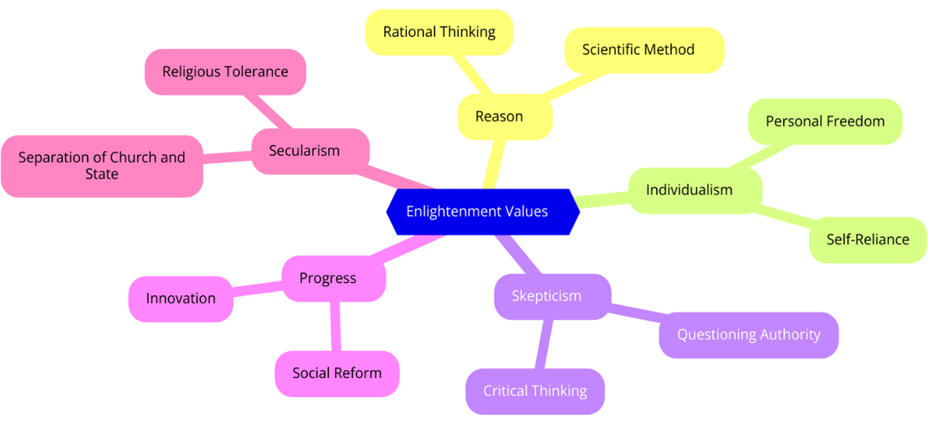
Enlightenment Values: Enlightenment thinkers like Descartes, Rousseau, Kant, and Locke moved away from religion towards science, promoting continuous progress free from superstition and irrationality. Hegel's progression from Family to Civil Society to State exemplifies this inevitable advancement.
Rational Knowledge for Social Progress: Enlightenment thought emphasized that rational knowledge solves social problems, ensuring societal improvement through scientific discoveries and advancements in engineering, architecture, medicine, and social sciences.
Political Rationalism: Ideas like freedom of speech (Voltaire), separation of powers (Montesquieu), and general will (Rousseau) laid the foundation for democratic societies, suggesting an inevitable political evolution towards justice and equality.
Post-Enlightenment Ideas of Progress:
Philosophy of History: In the early nineteenth century, the philosophy of history emerged, assuming society progressed from simple to complex stages. Ex-Comte’s three stages of society.
Evolutionary Biology: Sociology adopted an evolutionary approach to identify and explain the main stages of social evolution. Ex- Spencer’s work- Simple—Complex—Doubly Compound—Trebly Compound societies.
Social Survey: The social survey is crucial in modern sociology, emerging from the belief that natural science methods could study human phenomena and the recognition of poverty as a social issue. It assumes that understanding social conditions can help address social problems.
Material Changes:
European modernity introduced several changes in material domain of European society showing sign of progress and evolution.
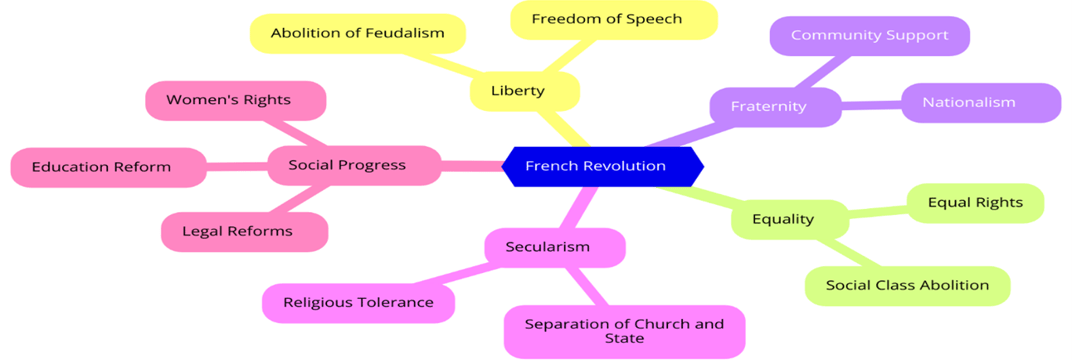
French Revolution established bourgeoisie democracy and rights to people on the basis of the principles of equality, liberty and fraternity. It was a massive political progress vis-à-vis feudal monarchical society. Ex-suffrage, political and social rights, welfare state, social movements and so on.
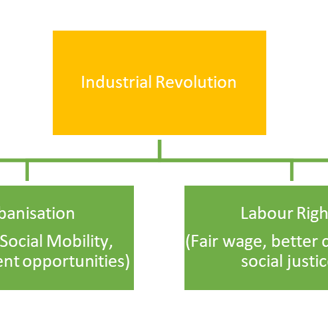
The Industrial Revolution spurred technological innovation, economic growth, urbanization, labour rights, public health improvements, expanded education, political reforms, scientific problem-solving, and early environmental awareness, all fostering the belief in continuous societal progress.
These ideas collectively reinforced the belief in continuous societal improvement through technological, economic, social, and political advancements.
Counter Viewpoints:
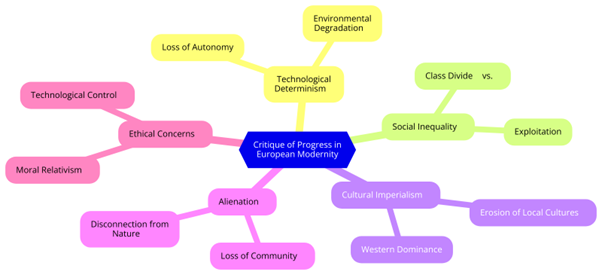
However, European modernity was also critiqued by scholars:
Conservatives (Counter-Enlightenment thinkers), such as de Bonald and de Maiste, were sceptical of the idea of progress, arguing that it does not equate to human betterment. They believed European modernity disrupted social cohesion, eroded traditions, increased dehumanization and exploitation of workers, and led to a loss of moral compass.
Eurocentric: European modernity looked at world from European perspective and European modernity produced colonial endeavours, economic disparities, Homogenisation of cultures, linear notion of progress and so on.
·
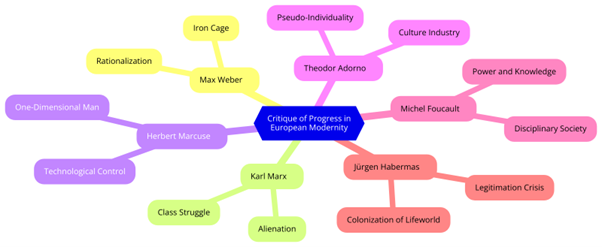
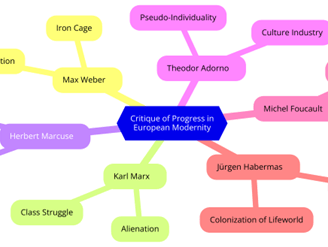
Sociologists on the critique of the notion of progress:
Conclusion:
Jean-François Lyotard, a key postmodernist sociologist, acknowledges the advancements brought by European modernity, such as technological progress, improved living standards, and democratic governance. However, he critiques the overarching narrative of progress for often concealing power imbalances and marginalizing non-Western knowledge and cultures. Lyotard warns that this singular focus on progress can lead to dehumanization, environmental harm, and cultural homogenization. He advocates for a more critical and inclusive approach to progress, one that appreciates diverse perspectives and addresses social and environmental justice.